How Reliable Transportation Can Instantly Improve Patient Flow in Your Facility
Walk any unit at 2pm and you’ll find it: the patient who was discharge-ready at 10:30, dressed and sitting on the bed — waiting on a van. That bed is blocked, the admission upstream is boarding, the charge nurse has called the transportation company twice, and the family is getting an apology instead of a goodbye. Flow initiatives usually mean committees, construction, or software. This one means changing who you call for the ride — and the effect shows the first week.
Transportation is the last mile of nearly every patient movement your facility makes — and when it’s unreliable, it quietly degrades five flow metrics at once: discharge-to-departure time, discharge-by-noon rate, upstream boarding behind blocked beds, treatment-schedule integrity, and the staff hours burned chasing rides. Unlike most flow levers, this one is a vendor decision, not a project: a partner with exact pickup times, standing discharge windows, and ambulatory + wheelchair + stretcher capability in one phone number changes those numbers the first week. The vetting standard is below — and the lowest-risk way to test any provider, including us, is one real trip.
The Bed That’s Ready But Not Empty
Patient flow conversations tend to focus on the big machinery — ED throughput, staffing ratios, bed management software. But one of the most common blockages is humbler: a discharge order is written, the patient is ready, and the bed stays occupied because the ride isn’t there. Every minute of that gap is pure, avoidable length-of-stay — and it cascades. The medicine floor can’t accept from the ED, the ED boards, PACU holds, and by late afternoon the whole house is running behind a van that was “on the way” since lunch.
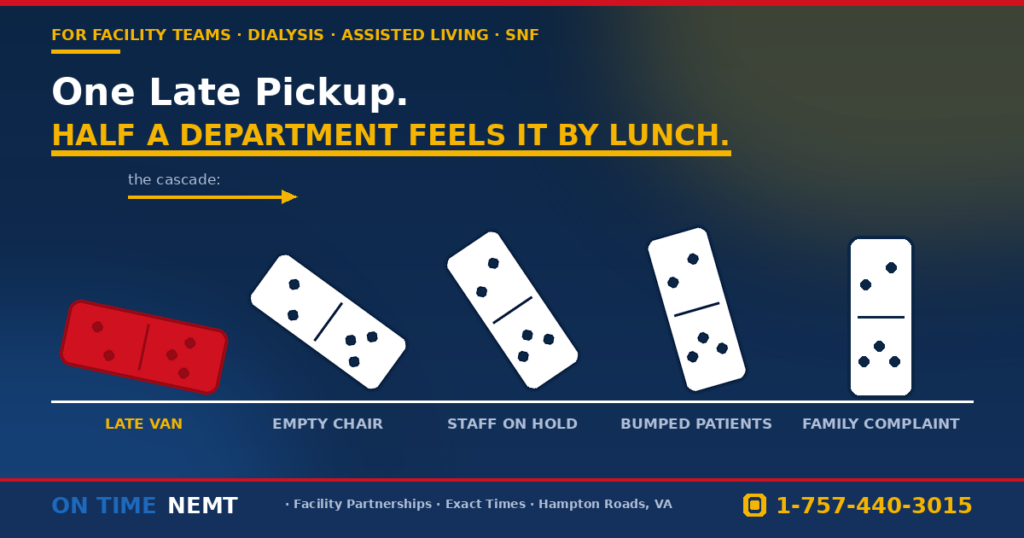
The outpatient version is just as costly: dialysis and infusion chairs sitting idle because the 7am pickup ran late, clinic schedules compressing into the afternoon, and no-show rates that are really no-ride rates. We’ve written the full anatomy of how a single late pickup unravels a facility’s day — the domino effect of one late NEMT pickup — including the illustrative staff-hours math. This article is the other side of that coin: what the numbers look like when the rides simply work.
Five Flow Metrics Transportation Touches — All at Once
1Discharge-to-departure time
The interval between “order written” and “bed empty” is the flow metric transportation owns outright. A provider that arrives at the scheduled minute — not inside a two-hour window — converts discharge-ready directly into bed-ready. The ride is the last mile of length of stay; shorten it and LOS shortens with it, one discharge at a time.
2Discharge-by-noon rate
Every facility chases morning discharges; few hit them, and transportation is a quiet reason why. Standing morning discharge windows — a vendor committed to 9am and 10am pickups daily, scheduled in advance rather than summoned after the order — are the difference between a discharge-by-noon goal and a discharge-by-noon number.
3Upstream decompression
Blocked beds don’t stay local. Each one backs up an ED admission or a PACU transfer, and boarding hours accumulate in the departments with the least slack. When discharges leave on time, the relief propagates upstream the same afternoon — the rare flow improvement the ED feels without anyone touching the ED.
4Treatment & clinic schedule integrity
For dialysis, infusion, wound care, and outpatient clinics, chair utilization is the business — and arrivals are the input. Standing schedules with exact times keep chairs turning and prevent the compressed-afternoon spiral where one late arrival reshuffles every appointment after it. (The facility-side fix list lives in our delays guide.)
5Staff hours and the family’s last impression
Unreliable transportation taxes your payroll invisibly: nurses calling dispatch, case managers rebooking, unit clerks apologizing. Reliable transportation refunds those hours — and upgrades the moment families remember most. The discharge ride is your facility’s final handshake; a courteous driver who arrives on time is the last impression that follows the family home, and into the survey.

The Rare Flow Fix That Works the First Week
Most patient-flow initiatives are measured in quarters: recruiting takes months, construction takes years, process redesign takes a committee. Transportation is different in kind — it’s a vendor decision. The day a facility switches to a provider with exact times and standing windows, tomorrow’s 9am discharge leaves at 9am. The standing dialysis runs stabilize within the week. The charge nurse’s ride-chasing calls stop immediately, because there’s a dispatcher’s direct line instead of a call center.
Transportation won’t fix a staffing shortage, a placement bottleneck, or a prior-auth delay — those are their own battles. What it fixes, completely and immediately, is the delay layer your facility has the most direct control over and usually examines last. “Instantly” is honest here for one reason: the fix is a phone call, not a project plan.
What “Reliable” Must Mean Before You Sign
Every transportation company calls itself reliable. Facilities should make them prove it against a checklist — ours included:
The facility’s six requirements:
Put these in the vendor conversation — a provider built for facilities answers all six without flinching.
- Exact pickup times — never windows.A two-hour window is the old standard talking. Your discharge sequence runs on minutes.
- Standing discharge windows and treatment schedules.Committed morning slots, every day, scheduled in advance — not summoned per-trip.
- All three service levels, one phone number.Ambulatory, wheelchair, and bed-to-bed stretcher — so no discharge waits on finding the right company.
- A direct line to a dispatcher with authority.When a discharge moves up an hour, your desk needs a person, not a queue.
- Drivers you’d put in front of any family.Background-checked, courteous, consistent — they are your facility’s last impression.
- A stated consequence for failure.Ask every vendor: “What happens when you’re late?” Our answer is on the van — on time, or the ride is free.
This checklist is the facility edition of the standard we’ve published and hold ourselves to publicly: reliability, communication, and accountability — the new standard in medical transportation, including the 5-question test your team can run on any provider. Including us.
Built for Facility Work Across Hampton Roads
We run discharge and treatment transportation for facilities throughout the region — hospitals, skilled nursing, assisted living, dialysis and infusion centers, and surgery centers — coordinated directly with discharge desks and charge nurses, with facility partnership accounts and consolidated invoicing available:
The lowest-risk evaluation is one real trip: give us a scheduled discharge or a recurring treatment run and judge the execution — we offer facility decision-makers a no-cost introductory ride for exactly that reason. Rates are flat and published, our reviews sit at 5.0, and a real person answers 1-757-440-3015.
Frequently Asked Questions
How does transportation actually affect patient flow?
Why “instantly,” when every other flow initiative takes months?
What should we require from a transportation partner?
Can one provider cover ambulatory, wheelchair, and stretcher discharges?
How does billing work for facilities?
What’s the lowest-risk way to evaluate you?
Keep Reading — The Facility Series
One Vendor Change.
Five Flow Metrics, the First Week.
Standing discharge windows, exact times, all three service levels, and a dispatcher your desk can actually reach. Start with one real trip — on us.
Or call us directly: 1-757-440-3015On Time NEMT · 3837 Larchwood Drive, Virginia Beach, VA 23456 · Facility discharge, wheelchair & stretcher transport · Serving Chesapeake, Norfolk, Virginia Beach, and expanding across Virginia. On-time-or-free guarantee requires a scheduled pickup time that allows on-time arrival and rider ready at pickup. Illustrative operational examples; results vary by facility.