How to Get Your Elderly Parent to Their Doctor’s Appointments When You Can’t Drive Them
Maybe you’re three states away. Maybe you’re at work when cardiology has openings. Maybe you’re driving your own kids in the opposite direction at 9am. Whatever your version looks like, the arithmetic is the same: Mom has appointments, you have a life that can’t absorb them all, and every missed ride feels like a personal failure. It isn’t. What it is, is a logistics problem — and logistics problems have solutions you can set up from anywhere, starting today.
You don’t need to become your parent’s driver — you need to become their transportation coordinator, which you can do from anywhere. The system: 1) pick a primary ride option matched to your parent’s mobility (professional NEMT for reliability; volunteer programs or paratransit where budget rules; family only as a supplement, never the whole plan), 2) set recurring appointments on a standing schedule so nobody has to remember to book, 3) arrange payment and confirmations remotely so you know every ride happened, and 4) keep one backup option tested and ready. Full playbook below.
First: The Guilt Isn’t a Plan — A System Is
Here’s the trap most adult children fall into: treating every appointment as a fresh crisis to be solved with heroics. You take the morning off. You beg a sibling. You reschedule the appointment — again — and the follow-up slides three more weeks. The hero model has a 100% failure rate eventually, because you are one person with a job, a family, and a finite supply of vacation days.
The families who make this work don’t drive more. They coordinate better. They stop being the ride and start running the system — and a system has three properties heroics never will: it doesn’t depend on any one person’s Tuesday, it survives your busy season, and it keeps working when you’re on vacation, in a meeting, or 400 miles away.
Every Ride Option, Honestly Compared
Six realistic ways to get a parent to appointments without you behind the wheel — with the honest trade-offs of each:
The family-and-friends rotation
Siblings, neighbors, church friends. Free and familiar — and fine as a supplement. As the whole plan, it collapses under its own politeness: your parent hates asking, helpers have their own lives, and the coordination text thread becomes your second job. Use it for the occasional trip, never for the dialysis schedule.
Volunteer driver programs
Nonprofits, faith communities, and Area Agencies on Aging run volunteer ride programs in many areas — genuinely wonderful where they exist, at little or no cost. The honest limits: volunteer supply is chronically short, booking windows are long, hours are limited, and drivers generally can’t provide physical assistance or handle mobility equipment. Worth applying for; risky to depend on alone.
Public paratransit
In Hampton Roads, HRT paratransit offers economical ADA transportation — after an eligibility application. Rides are shared, booked in advance, and scheduled in windows rather than exact times, which means long waits are built in. Solid for flexible trips on a tight budget; a poor fit for hard appointment times or a parent who can’t tolerate waiting.
Rideshare (with or without a senior concierge service)
Uber and Lyft work for tech-comfortable, fully mobile seniors — and concierge services exist that book rideshares by phone for older adults. The gaps: drivers aren’t trained or required to assist, no help from door to car, wheelchairs don’t fit standard vehicles, cancellations spike at exactly the worst moments, and the driver lottery means a different stranger every time. For a parent with any mobility or memory concern, this is the option that fails suddenly and without apology.
Home care aides who drive
If your parent already has (or needs) in-home care, many agencies offer transportation plus accompaniment — the aide attends the appointment, takes notes, and reports back. Excellent when appointment support matters as much as the ride. The trade-off is cost structure: you’re typically paying hourly for the aide’s full time, which makes ride-only trips expensive.
Professional senior medical transportation (NEMT)
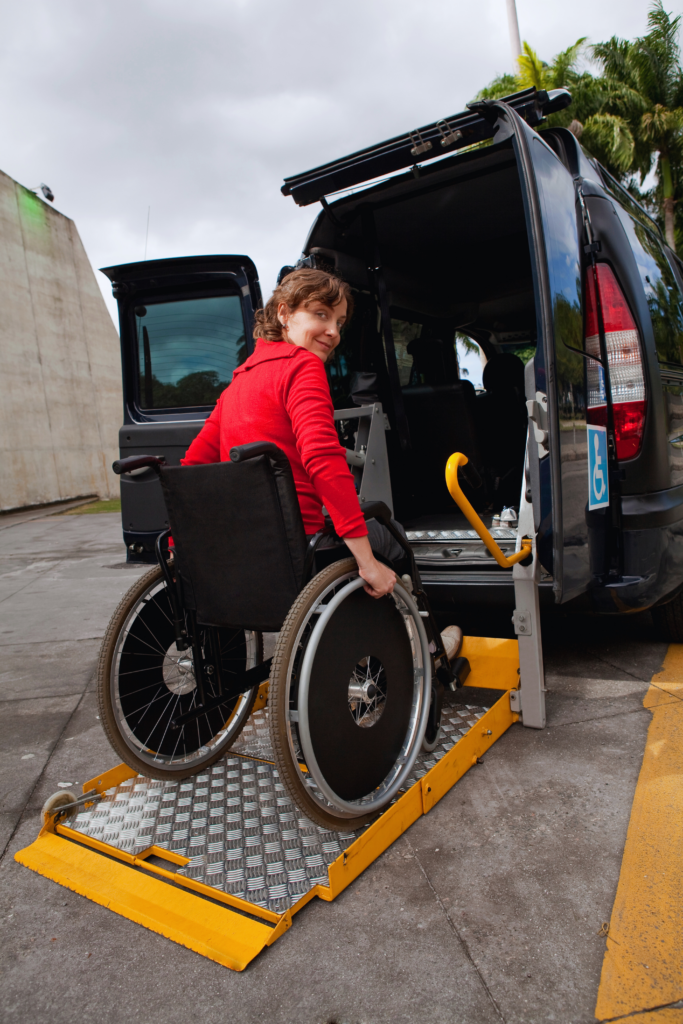
A service built for exactly this: trained drivers, door-to-door assistance (from her front door to the check-in desk — not a curbside drop), vehicles for every mobility level from ambulatory to wheelchair to stretcher, exact pickup times, standing schedules for recurring appointments, and — the part that matters most for you — the whole thing can be booked, paid, and monitored remotely by an adult child anywhere in the country. This is what we do; rates are published on our pricing page.
Most families land on a blend: a professional service as the dependable core for medical appointments, family for social trips, and maybe a volunteer program or paratransit for flexible errands. The mistake isn’t choosing any one option — it’s having no designated primary, so every appointment starts from scratch.
The Remote Coordination Playbook — Run It All From Your Phone
This is the part nobody writes about: how to actually operate your parent’s transportation from a different city, a different state, or a desk you can’t leave. Five steps, one afternoon to set up:
Pick one primary provider and build the relationship
One phone call introduces you as the coordinator: your parent’s name, address, mobility level, and quirks (“Dad walks with a cane and will absolutely tell the driver he doesn’t need help — he needs help”). A provider who takes notes and asks follow-up questions is a keeper. One number in your phone replaces the whole scramble.
Put recurring appointments on a standing schedule
Dialysis, therapy, the monthly cardiology check — set once, honored every time, with nobody needing to remember to book. Standing schedules are the single highest-leverage move a long-distance child can make: they convert an endless series of tasks into zero tasks.
Set up remote payment
Card on file or pay-by-phone, so your parent never handles money, writes checks, or feels the cost in the moment. You see every charge; she just sees the ride arrive. (With us, itemized receipts also make reimbursement claims painless if her plan offers any ride benefit.)
Build in verification — so you’re not wondering at 10:15
Ask the provider what confirmations they offer; ask the doctor’s office to list you as a contact so the front desk can confirm arrival; or set a standing “I’m in the waiting room” call with your parent. The goal is a system where silence means everything’s fine — not a morning of refreshing your phone.
Write the one-page brief
Five lines in a note app: mobility equipment, medications list location, emergency contacts, preferred pharmacy, and anything drivers should know. Share it with the provider and any family backup. When anyone steps in — a sibling, a new driver, you from afar — the system briefs them instead of you.
Build Backup Layers — So One Miss Never Becomes a Crisis
Even good systems hiccup. The difference between a hiccup and a crisis is whether a backup already exists. Three layers cover almost everything:
Primary: your chosen provider on standing schedules and booked appointments — the default that handles 95% of trips.
Backup: one tested alternative — a sibling who’s agreed to be the named backup, a neighbor with a standing offer, or a second provider whose number is saved. The key word is tested: a backup you’ve never used is a hope, not a plan.
Emergency: the rule your parent knows by heart — if a ride ever falls through for an urgent appointment, she calls you (or the designated sibling), and nobody just “waits to see.” For genuinely medical emergencies, that’s 911, full stop — non-emergency transport is never the answer when minutes matter.
The first-ride test (run this before you rely on anyone)
- Book a low-stakes trip first — a haircut, lunch with a friend — not the cardiology follow-up
- Watch the clock: did the vehicle arrive at the scheduled time, or “within a window”?
- Watch the door: did the driver come to the door and assist, or honk from the curb?
- Ask your parent afterward: “Would you be comfortable riding with them again?” — her answer is the real review
- Test the phone line: call with a question; count how long it takes to reach a human who knows something
One more honest word about the guilt, since it tends to return: coordinating from afar isn’t a lesser form of caring — it’s often a better one. The parent whose rides simply work, without her having to ask anyone for favors, keeps her appointments, her independence, and her dignity. That’s what you’re building. That’s not less love; it’s more competence.
Senior Medical Transportation Across Hampton Roads
If your parent is in Hampton Roads — and you’re here, or anywhere — this is exactly what we’re built for: door-to-door senior transportation with trained drivers, exact pickup times, standing schedules, remote booking and payment for out-of-town family, and updates so you always know the ride happened. Locally owned, headquartered in Virginia Beach, expanding across Virginia:
One call sets up the whole system — the standing schedule, the payment, the confirmations, the driver briefing. Current flat rates are always on our pricing page, and our 5.0-star Google reviews include more than a few adult children who coordinate their parent’s rides from hundreds of miles away.
Frequently Asked Questions
Is it safe for my parent to ride alone?
How do I arrange and pay for rides from out of state?
How do I know my parent actually arrived?
What if my parent uses a walker or wheelchair?
Does Medicare pay for rides to appointments?
How far ahead should I book?
What if my parent refuses help?
Keep Reading
You Coordinate. We Drive.
Mom Gets There — Every Time.
One call sets up the standing schedule, the remote payment, and the confirmations — whether you’re across town or across the country. Locally owned in Virginia Beach, serving all of Hampton Roads.
Or call us directly: 1-757-440-3015On Time NEMT · 3837 Larchwood Drive, Virginia Beach, VA 23456 · Serving Chesapeake, Norfolk, Virginia Beach, and expanding across Virginia.