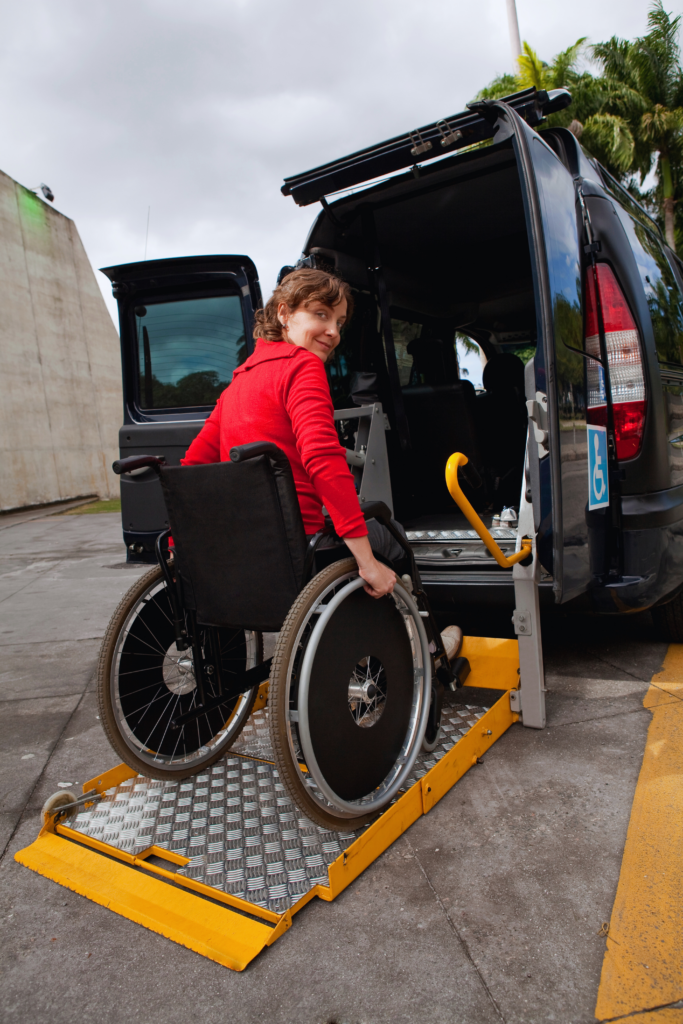
Wheelchair Won’t Fit in the Family Car? Here Are Your Real Options.
It usually hits in a driveway. The appointment is Thursday, the wheelchair is here, the sedan is right there — and the math doesn’t work. Maybe the chair won’t fold. Maybe it folds but weighs more than anyone can lift. Maybe your dad can’t safely make the transfer from chair to car seat anymore. Whatever the reason, you need a real answer, not a sales pitch for a $60,000 van. Here’s every option that actually exists — with the honest pros, cons, and who each one is right for.
When a wheelchair won’t fit in the family car, your real options are: 1) transfer the rider and fold the chair (only works if both are possible), 2) add a lift, topper, or trailer to your vehicle (an equipment purchase — best for frequent self-driving), 3) rent a wheelchair-accessible van (best for multi-day needs), 4) buy a converted van (a major purchase for daily, long-term need), 5) try a wheelchair-accessible rideshare (unreliable supply), 6) apply for paratransit (economical but slow and windowed), or 7) book a professional wheelchair transportation service — the practical answer for most medical trips. Full comparison below.
Most articles on this topic are written by companies that sell lifts, toppers, and vans — so every “solution” involves buying equipment. This one starts somewhere different: with the two questions that tell you which options are even on your table.
The Two-Question Test That Narrows Everything Down
- Question 1: Can the rider safely transfer from the wheelchair into a car seat? Not “could they on a good day with three helpers” — can they do it routinely, safely, without pain or fall risk? Post-surgery restrictions, severe weakness, balance problems, and many neurological conditions make the honest answer no.
- Question 2: Can the chair itself go in your vehicle? A folding manual chair in a roomy trunk — often yes. A rigid-frame manual chair, a bariatric chair, or any power wheelchair (150–300+ lbs, usually non-collapsible) in a sedan — no. Measure before you assume.
If both answers are yes — genuinely good news: the family car still works for many trips, and your challenge is technique, not equipment. Lock the brakes, position the car close, let the rider lead the transfer pace, stow the folded chair. Options 1 and 2 below are your lane.
If either answer is no — the rider needs to travel in the wheelchair, which means a vehicle built for it: ramp or lift, securement points, and headroom. That’s options 3 through 7, and the rest of this guide helps you pick between them.
All 7 Options, Honestly Compared
Transfer + fold the chair in the trunk
The classic. If the rider transfers safely and the chair folds and lifts, this costs nothing and keeps spontaneity alive. Its limits are physical: it fails the moment transfers become unsafe, the chair is powered or rigid, or the person doing the lifting develops the back problems this method famously creates.
Add equipment to your vehicle — lift, topper, or trailer
Hitch-mounted lifts, roof toppers for folding chairs, and small trailers can carry the chair — but read that carefully: the rider still has to transfer into a regular seat. These are genuinely good for active wheelchair users who drive themselves and transfer independently. They run from several hundred to a few thousand dollars installed, and they solve nothing if Question 1 was a no.
Rent a wheelchair-accessible van
Accessible minivan rentals exist in most metro areas, typically by the day or week. This shines for multi-day needs — a beach week with grandma, several days of family visits — where having the vehicle on hand beats booking individual rides. The honest caveats: daily rates add up fast, availability can be tight (book early), and someone in the family has to be comfortable driving it and operating the ramp and tie-downs correctly. Securement done wrong is the most common DIY mistake, and it matters at the first hard brake.
Buy a converted wheelchair van
The right answer for daily, long-term, everyday need — school runs, work, full family life on wheels. It’s also a major purchase: new conversions commonly reach into tens of thousands of dollars above the base vehicle, used ones require careful inspection of the conversion components, and the vehicle only pays for itself with constant use. If the actual need is a few medical trips a month, the math almost never works — you’d be buying a van to solve an appointment problem.
Wheelchair-accessible rideshare (WAV)
Uber and Lyft offer wheelchair-accessible vehicle options in some markets. When one shows up, it works. The problem is the “when”: WAV supply is thin almost everywhere, drivers aren’t required to provide door-to-door assistance, and there’s no guarantee a vehicle accepts your request at all — least of all at 8am on the day of a specialist appointment you waited two months for. Fine as a backup for flexible trips; a gamble for anything that matters.
Public paratransit
In Hampton Roads, HRT paratransit provides ADA transportation at genuinely economical fares. The trade-offs are structural: an eligibility application before you can ride at all, advance booking, shared rides with other passengers, and pickup windows rather than exact times — meaning long waits are built into the model, especially on longer routes. A valuable service for flexible, budget-conscious trips; a poor fit for appointments with hard start times or riders who can’t tolerate extended waiting.
Book a professional wheelchair transportation service
This is the option most families haven’t heard of until they need it: a service whose entire job is transporting people in wheelchairs. The van arrives with a hydraulic lift, your parent rides in their own chair secured with a 4-point tie-down plus lap and shoulder belt, and a trained driver provides door-to-door assistance — from the front door, into the van, to the destination entrance. No transfers, no equipment to buy, no ramp technique to learn, and a scheduled pickup time instead of a window. Manual chairs, power chairs, and scooters all accommodated; family members can ride along; recurring trips can run on a standing schedule. For occasional-to-weekly medical trips — the situation most families searching this topic are actually in — it’s the practical answer. (This is what we do; current rates are always on our pricing page.)
Match the Option to Your Situation
| Your Situation | Best Option | Why |
|---|---|---|
| Rider transfers easily, chair folds | Family car (Option 1) | Free and flexible — just learn safe transfer technique and protect the lifter’s back. |
| Independent wheelchair user who drives | Vehicle equipment (Option 2) | A lift or topper preserves independence with your existing vehicle. |
| A vacation week or several consecutive days of trips | Rent a WAV (Option 3) | Having the vehicle on hand beats booking many individual rides. |
| Daily, everyday, long-term need | Buy a converted van (Option 4) | Constant use is the only math that justifies the purchase. |
| Flexible trip, no time pressure, tight budget | Paratransit (Option 6) | Economical if you can absorb the application, windows, and shared rides. |
| Medical appointments — occasional or recurring | Wheelchair transport service (Option 7) | Exact times, trained assistance, no equipment — built for exactly this. |
| Rider can’t sit upright at all | Stretcher transport | Beyond wheelchair options entirely — see stretcher service with a 2-person crew. |
And a note on mixing: these aren’t exclusive. Plenty of Hampton Roads families use the sedan for good days, paratransit for errands, and a scheduled wheelchair service for the cardiology appointment that can’t be missed. The goal isn’t one perfect answer — it’s never again standing in the driveway doing impossible math.
Wheelchair Transportation Across Hampton Roads
If Option 7 fits your situation, this is what it looks like here: ADA vans with hydraulic lifts, 4-point securement on every ride, trained drivers who assist door-to-door, exact pickup times, family riders welcome, and standing schedules for dialysis, therapy, and recurring appointments. Locally owned, headquartered in Virginia Beach, expanding across Virginia:
Current rates are always on our pricing page — flat, all-inclusive, no per-mile meter. And our 5.0-star Google reviews include plenty of families who found us from exactly the driveway moment this article describes.
Frequently Asked Questions
Can you transport a power wheelchair in a regular car?
Do I need a wheelchair van to transport my parent?
How do people get to appointments without owning a van?
Is it better to rent a van or book a transport service?
Does insurance or Medicare pay for wheelchair transportation?
What does a wheelchair transport service actually include?
Keep Reading
Skip the Driveway Math.
One Call, Chair and All.
Tell us the pickup, the destination, and the chair type — manual, power, or scooter. The right van arrives at an exact time with a trained driver who handles everything. Locally owned in Virginia Beach, serving all of Hampton Roads.
Or call us directly: 1-757-440-3015On Time NEMT · 3837 Larchwood Drive, Virginia Beach, VA 23456 · Serving Chesapeake, Norfolk, Virginia Beach, and expanding across Virginia.