
The #1 Complaint from Dialysis Centers About NEMT (And How to Fix It)
If you run, manage, or work in a dialysis center, you already know the answer before you finish reading the headline. But what you might not know is how much it’s actually costing your facility — and how straightforward the fix really is.
Walk into any dialysis center charge nurse station in Virginia at 6:30 in the morning and listen for ten minutes. You will hear the same conversation in Chesapeake, in Norfolk, in Virginia Beach, in Richmond, in Roanoke. “Has the patient in chair 7 been picked up yet?” “Broker says they’re on the way.” “They said that 40 minutes ago.”
This is not anecdote. This is the daily reality of dialysis treatment in America, and it points directly to the #1 complaint from dialysis centers about NEMT. The complaint is so universal, so persistent, and so well-documented that almost every facility administrator could finish the sentence before the question is asked.
The complaint is unreliability. Specifically: late pickups and no-shows that disrupt the treatment schedule.
Driver attitude, vehicle cleanliness, communication breakdowns, broker scheduling friction — these all show up on the complaint list, and we’ll cover them. But every survey of dialysis facility administrators, every social-worker interview, every dialysis center operations review puts unreliability at the top of the list, and it is rarely close. This article explains why the problem exists, what it actually costs your facility, and — most importantly — exactly how to fix it.
What’s in this article
The #1 Complaint, Named Clearly
When a dialysis administrator complains about NEMT, they are almost never complaining about price. They are not really complaining about paperwork. They are complaining about a specific, repeating event: a patient was supposed to be at the center at 5:30 AM, the broker assigned the trip, the vehicle never came (or arrived 45 minutes late), and the treatment chair sat empty or the session ran short.
That single event — the late or missed pickup — is the entire complaint. Everything else is a downstream symptom.
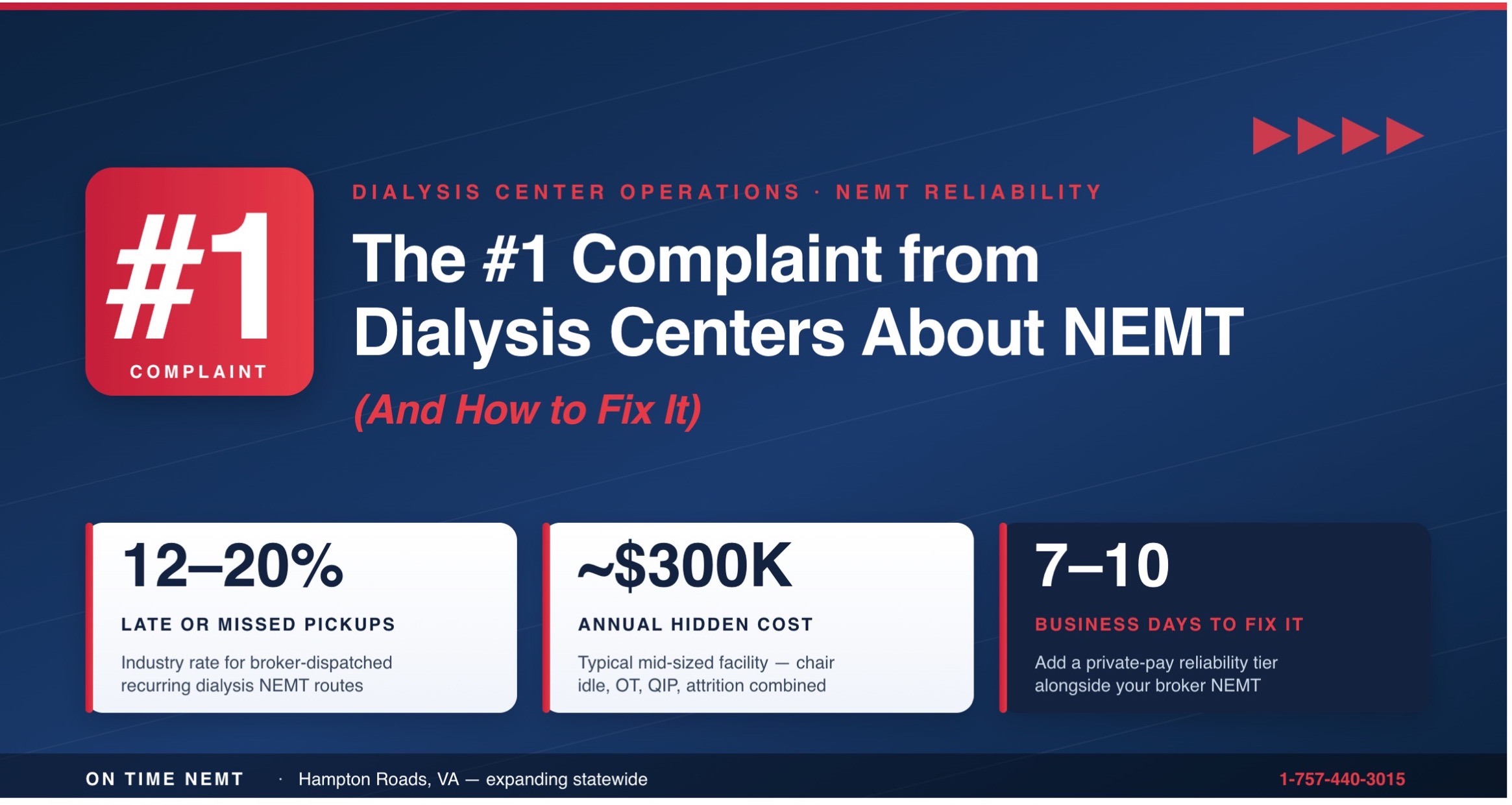
How common is it? Industry reports on Medicaid broker NEMT cite combined late-arrival and no-show rates of 12 to 20 percent for recurring dialysis routes. That means at a typical mid-sized dialysis facility serving 75 hemodialysis patients, somewhere between 800 and 1,300 NEMT trips per year arrive late or never arrive at all. Even the optimistic end of that range is a major operational disruption.
The Runners-Up: Complaints That Flow From The Same Source
Once you understand that the #1 complaint is reliability, the rest of the dialysis-NEMT complaint list reads like a symptom tree. Here are the secondary complaints administrators raise — and how each one traces back to the underlying unreliability problem.
Communication Breakdowns
“The broker doesn’t return calls.” “The driver didn’t tell us they were running late.” “We had no idea the patient was rescheduled.” Communication failures sit second on most complaint lists — but they exist because the underlying schedule is unreliable. When pickups happen on time, there’s nothing to communicate.
Driver Inconsistency
“We get a different driver every week.” Recurring dialysis patients build a routine — and a relationship — with the right driver. When broker dispatch rotates drivers daily, patients with cognitive impairments get confused, post-treatment fatigue isn’t anticipated, and route timing slips. Driver inconsistency is itself a reliability failure.
Vehicle Quality and Cleanliness
“The wheelchair lift wasn’t working.” “The van smelled.” Equipment failures and dirty vehicles often come from over-utilized fleets running on tight margins. They are the same business problem expressed in a different form: a fleet pushed too hard to meet broker volume targets is a fleet that breaks down and cuts corners on cleaning.
Post-Treatment Handling
“The driver wouldn’t help the patient out of the chair.” Post-dialysis hypotension and fatigue are predictable. Drivers who know their dialysis patients anticipate it and assist patiently. Drivers handed a one-off trip from a broker queue often don’t know what they’re picking up — another consequence of the route-consolidation pressure that creates the reliability problem in the first place.
Same-Day Cancellations and Reassignments
“The broker called at 4:45 AM and said no driver was available.” Same-day broker cancellations are the most extreme expression of the reliability problem. They force the dialysis center to bump treatment, file the patient as a no-show, or scramble to find alternative transport.
Notice the pattern. None of these are independent problems. They all sit downstream of the same underlying issue: a broker-dispatch model optimized for cost and volume rather than for reliability on high-stakes recurring routes.
Why Unreliability Is Structural, Not a Vendor Problem
Many dialysis administrators have worked through three or four NEMT vendors looking for one that’s “actually reliable” and concluded — correctly — that the problem isn’t any single company. The problem is structural to how Medicaid NEMT is paid.
Here is the cycle, simply stated:
- State Medicaid sets a low fixed rate for NEMT trips — typically $25 to $90 for ambulatory dialysis trips and $45 to $120 for wheelchair trips, depending on the state.
- A transportation broker contracts with the state to manage the entire NEMT benefit and contracts with NEMT providers below those rates.
- NEMT providers must hit volume targets to make those low rates economically viable, which forces route consolidation — packing as many trips as possible into each driver’s shift.
- Route consolidation creates fragility. If one trip earlier in the morning runs long, every subsequent trip on that route is late. The system has no slack.
- When the system breaks, dialysis trips lose. A 45-minute late pickup at a doctor’s office is annoying. A 45-minute late pickup at a dialysis center cuts into a four-hour treatment.
This is not a story about lazy brokers or careless providers. It is a story about an economic model that produces predictable outcomes. Reliability requires slack capacity, and slack capacity costs money. A system priced to eliminate slack will produce reliability failures — by design.
What This Complaint Is Actually Costing Your Facility
Most dialysis center administrators, when pressed, can name two or three categories of cost from unreliable NEMT. The full list is longer — and the total is bigger than most facilities have ever sat down to calculate.
💺 Chair idle time
Each Medicare ESRD bundled rate session generates roughly $260–$290 of revenue. A 30–45 minute late patient creates partial chair idle time the center cannot recover. Annualized across hundreds of late events, this is six-figure exposure on its own.
👩⚕️ Staff overtime
Dialysis RNs and technicians billing $45–$75 per hour at OT rates, staying late to complete bumped sessions. One disruptive patient route can generate $3,000–$9,000+ per year in avoidable overtime.
📋 Rescheduling labor
Each no-show consumes 45–90 minutes of front-desk and social-worker time chasing brokers, rescheduling sessions, and updating care plans. That’s clinical staff time stolen from clinical work.
📊 CMS QIP exposure
The ESRD Quality Incentive Program reduces Medicare payment by up to 2% for underperformance. Missed treatments degrade adequacy scores (Kt/V), hospitalization rates, and fluid management — all reliability-sensitive metrics. On a $5–$8M Medicare revenue base, the swing is $100K–$160K.
🚑 ED visits and hospitalizations
Patients who miss entire dialysis sessions due to transport failure can develop fluid overload or hyperkalemia. These end up in the ED at $8K–$30K+ per event, a cost increasingly borne by facilities under accountable-care arrangements.
👥 Patient attrition
Lifetime value per dialysis patient: $60K–$120K in Medicare revenue. Even one patient leaving a year from transportation frustration is a meaningful financial event — and patient satisfaction scores carry their own weight in modern dialysis economics.
The honest total. For a typical mid-sized dialysis center, the combined hidden cost of unreliable NEMT is routinely in the mid-six figures per year — and it is largely invisible because it never appears as a single line item. We walked through the full math in our companion article, Breaking Down the Real Cost of Unreliable NEMT for Dialysis Centers.
Why Complaining to Your Broker Won’t Fix It
This is the conversation no one wants to have, but it’s the most important one in the article. Dialysis administrators who have escalated through their NEMT broker’s chain of command — once, twice, ten times — eventually realize that the broker, however well-intentioned, cannot fix the problem from inside the model that creates it.
The broker’s economic incentives are structural. They are paid by the state on a per-trip or per-member basis. Their margin depends on holding provider rates down. Holding provider rates down forces route consolidation. Route consolidation produces unreliability. The broker can apologize, escalate, retrain, audit — and none of those interventions change the underlying math.
This is not a moral judgment. It’s a structural observation. And it points to an obvious conclusion: the fix has to come from outside the broker model.
The Actual Fix: Add a Reliability Tier Alongside Broker NEMT
The fix that works — and the one a growing number of dialysis centers in Virginia and across the country are now adopting — is to layer a private-pay NEMT reliability tier alongside the broker-dispatched Medicaid NEMT. The Medicaid benefit still exists for the patients who qualify and use it. But the facility supplements it with a contracted private-pay partner who handles the routes and patients where reliability has to be guaranteed.
Two models work, and most facilities use a blend.
A Per-Patient Replacement
Identify the 10–15 patients on the roster whose broker NEMT is the most unreliable, and contract a private-pay provider as their primary transport. At typical facility-volume rates, this runs $20K–$28K per patient per year, or $200K–$400K across the cohort.
Best for: centers with a small group of chronically affected patients driving most of the disruption.
B Facility-Concierge Backstop
Contract a private-pay NEMT provider as a guaranteed-reliability concierge tier — same-day rescue capacity, standing-order coverage for high-risk patients, and a single dispatcher accountable to the facility. Typical cost: $40K–$120K per year.
Best for: centers wanting maximum financial leverage from a smaller dedicated investment.
How to Implement the Fix in 7–10 Days
One reason this fix doesn’t happen at more facilities is that administrators imagine it as a six-month procurement project. It isn’t. A facility-level NEMT reliability partnership is faster to stand up than almost any other vendor relationship in the dialysis center, because there is no broker network, no prior authorization, and no claim-submission infrastructure to integrate.
Day 1–2: Discovery
30-minute call with the prospective NEMT partner. Share patient volume, route pain points, and your top 10–15 reliability-affected patients. No long RFP, no committee.
Day 3–5: Agreement
Written service agreement with facility-volume pricing, standing-order schedule, wait-time policy, communication SLA, and named single-point-of-contact dispatcher.
Day 6–7: Patient onboarding
Patient roster shared, mobility needs documented, recurring schedules built, family/caregiver contacts loaded into dispatch system.
Day 8–10: First rides
First scheduled rides run. Same dispatcher fields the first weeks of issues. No ramp period — the partner is built for recurring dialysis from day one.
Month 1–3: Measurement
Weekly review of late-arrival rate, no-show rate, overtime hours, and any QIP-relevant metrics for the affected cohort. The improvement should be visible by week three.
Quarter 2: Expansion (optional)
Most facilities expand the partnership in quarter two — adding more patient routes, lengthening wait-time coverage, or extending the standing order to cover additional shifts.
A Note for Dialysis Centers Across Virginia
On Time NEMT was founded in Hampton Roads, and we serve dialysis centers in Chesapeake, Norfolk, and Virginia Beach as our core operating market. We work with patients at every major regional dialysis center — DaVita, Fresenius Medical Care, Tidewater Kidney Specialists, Nephrology Associates of Tidewater, and Sentara-affiliated programs.
We’re also actively expanding our footprint across the Commonwealth. We currently take long-distance dialysis transports up to 240 miles, and we are actively building partnerships with dialysis facilities in Portsmouth, Suffolk, Newport News, Hampton, Williamsburg, Richmond, Petersburg, Charlottesville, Roanoke, and Northern Virginia. If your facility is somewhere we haven’t yet built dedicated capacity, that doesn’t mean we can’t help — it means the conversation should start sooner rather than later.
Frequently Asked Questions
What is the #1 complaint dialysis centers have about NEMT?
The #1 complaint dialysis centers consistently report about non-emergency medical transportation (NEMT) is unreliability — specifically, late pickups and no-shows that disrupt treatment schedules. Industry surveys and facility administrator interviews place late-arrival and no-show events at the top of the complaint list, well ahead of secondary issues like driver communication, vehicle condition, or scheduling difficulty. Late and missed NEMT trips force shortened or rescheduled dialysis sessions, cascade into staff overtime, and degrade quality metrics that affect Medicare ESRD payment.
Why are NEMT no-shows so common at dialysis centers?
NEMT no-shows are common at dialysis centers because the dominant Medicaid broker model is structurally optimized for low cost rather than reliability. Brokers contract with high-volume providers at fixed low per-trip rates, which incentivizes route consolidation, aggressive overbooking, and same-day reassignments. Recurring dialysis routes — though clinically high-stakes — are economically just another trip in the broker’s optimization queue. The result is a well-documented 12 to 20 percent rate of late or missed pickups across most regional broker networks.
How does an unreliable NEMT provider hurt a dialysis center financially?
An unreliable NEMT provider hurts a dialysis center across at least six measurable cost categories: chair idle time when patients arrive late, staff overtime when shifts run long, rescheduling labor when patients miss sessions, CMS Quality Incentive Program (QIP) payment exposure when missed treatments degrade quality scores, patient attrition when families lose trust, and downstream emergency department or hospitalization costs when patients miss treatments entirely. For a typical mid-sized facility, the combined hidden cost commonly reaches the mid-six figures per year. Full breakdown in our cost analysis article.
How do you fix the unreliability problem with NEMT for dialysis?
The proven fix is to add a private-pay NEMT reliability tier alongside the broker-dispatched Medicaid NEMT — either as a full replacement for the dialysis center’s most unreliable patient routes, or as a same-day backstop and concierge layer for the entire facility. Standing-order private-pay NEMT eliminates broker overbooking, gives dialysis centers a single dispatcher to call, and brings late-arrival and no-show rates down toward zero. Most dialysis centers find this tier pays for itself many times over in recovered chair utilization, reduced staff overtime, and improved QIP scores.
What does it cost to add a reliability-tier NEMT partner?
Cost varies with model and volume. A facility-concierge model — where a private-pay NEMT provider acts as the same-day backstop and standing-order partner for the highest-risk patient routes — typically runs $40,000 to $120,000 per year for a mid-sized dialysis center. A full-replacement model for the worst-reliability patient cohort runs higher but is often justified by avoided downstream costs. Most facilities recover the investment in QIP protection, recovered chair revenue, and reduced overtime within the first year.
Does On Time NEMT serve dialysis centers outside Hampton Roads?
Yes. While On Time NEMT is headquartered in Hampton Roads — actively serving dialysis centers in Chesapeake, Norfolk, and Virginia Beach — we are rapidly expanding our service footprint across the Commonwealth of Virginia. We currently take long-distance dialysis transports up to 240 miles, and we are actively building partnerships with dialysis facilities outside Hampton Roads that need a reliability-tier NEMT alternative. Call 1-757-440-3015 to discuss coverage in your area.
How long does it take to set up a facility NEMT partnership?
Most dialysis center NEMT partnerships with On Time NEMT can be operational within seven to ten business days. The setup includes a brief facility intake, a review of the patient roster and route pain points, a written service agreement, standing-order pickup schedules for designated patients, and a single-point-of-contact dispatcher assigned to your account. There is no long lead time and no broker red tape.
What if my facility uses a specific Medicaid MCO or broker?
It doesn’t matter. A private-pay reliability tier sits alongside whatever broker arrangement your patients have today — it does not replace it, conflict with it, or require any change to the patient’s Medicaid benefit. Patients can still use their Medicaid NEMT for any trip; the private-pay tier is the backup, the supplement, or the concierge layer for the trips where reliability has to be guaranteed. The two models coexist cleanly.
Related Reading
The Real Cost of Unreliable NEMT
The full financial breakdown of what late and missed NEMT trips actually cost a dialysis center — with a worked scenario for a 20-chair facility.
Read the Cost Analysis →NEMT Dialysis Service Overview
Our dedicated NEMT dialysis service page — local dialysis center coverage, recurring schedules, wheelchair transport, and booking details.
See the Service →Dialysis Transportation Services
Our full dialysis transportation menu, including post-treatment return trips, wait-time service, and long-distance options up to 240 miles.
Explore Services →The Fix Is a Phone Call Away.
If you run, manage, or staff a dialysis center anywhere in Virginia and you recognized your facility in this article — that’s not a coincidence, and it’s not your fault. It’s a structural problem with a structural fix. We’d be glad to walk through what a reliability-tier NEMT partnership would look like for your specific facility.