For Case Managers · Discharge Planners · Social Workers
The Frustration Every Case Manager Knows: Waiting on Transportation That Never Comes
📅 Updated October 19, 2026 · ⏱ 10 min read · 📍 Chesapeake · Norfolk · Virginia Beach · Virginia
The discharge order was signed at 11:00. The patient is dressed, the paperwork is done, the bed is already promised to someone in the ED. You booked the ride two days ago. Now it’s 2:40, the transportation line has you on hold for the third time, and the answer is the same one you heard at 1:15: “The driver is on the way.”
If you’ve worked in case management for more than a week, you know the frustration every case manager knows: waiting on transportation that never comes. It costs your patient an appointment, costs your unit a bed, and costs you an afternoon you didn’t have. This guide explains why it keeps happening, what a no-show really costs, and gives you a practical playbook — scripts, escalation timing, and a vetting checklist — so the next ride that fails doesn’t take your whole day with it.
The Short Version
Patient transportation fails case managers because of structure, not bad luck: wide pickup windows, overbooked shared routes, call centers with no authority, and no one who owns the outcome. You can’t fix the system, but you can protect your patients: book exact times with a buffer, confirm twice, escalate at 15 minutes, document every failure, and keep a dependable private-pay provider on file as your backup lane for the trips that can’t fail.

In this guide
Why Transportation Keeps Failing Case Managers (It Isn’t You)
When a ride doesn’t show, it’s tempting to blame yourself — maybe you should have called earlier, booked sooner, or pushed harder. But the pattern is national, and it’s been documented for years. In public testimony to Maine’s legislature, a long-time Medicaid transportation rider described waiting repeatedly for rides that never arrived, being sent inaccessible vehicles, and being marked a “no-show” for trips the driver missed. LeadingAge New York reported nursing home members across the state dealing with last-minute cancellations and late arrivals that caused missed appointments — to the point that some residents began paying privately for rides. A Wisconsin legislative audit specifically tracked provider no-shows and pickups more than 15 minutes late as a reportable problem.
Case managers absorb the fallout of transportation programs they don’t run. Here’s what is actually breaking underneath:
None of this means the drivers are bad people. It means the system was built for volume. That’s important, because it tells you where your leverage is: you can’t fix the structure, but you can choose who carries your most important trips, and you can build a process that catches failure early.
What One Transportation No-Show Really Costs
A missed ride is never just a missed ride. It ripples outward to three people at once:
| Who pays | What the no-show costs them |
|---|---|
| The patient | Missed dialysis, chemo, or specialist visits; hours waiting in a lobby or wheelchair; rescheduled procedures; anxiety that makes them want to skip the next appointment altogether. |
| You, the case manager | Hold time, re-booking, calls to family, rescheduling with the provider, documentation — work that pushes your actual caseload into the evening. |
| The facility | Delayed discharges, blocked beds, ED boarding, staff tied up supervising a waiting patient, and frustrated families who remember the experience. |
The flip side is just as measurable. When MD Anderson Cancer Center at Cooper used a coordinated ride service, it reported cutting its no-show rate to about 4% — and eight social workers and case managers booking recurring rides for 75+ patients saved more than $44,500 in staff time. A separate year-long pilot linked coordinated rides to a 27% drop in clinic no-shows. Reliable transportation doesn’t just help patients; it gives case managers their time back. (We go deeper on the facility side in the domino effect of one late NEMT pickup.)
The Case Manager’s 7-Step Transportation No-Show Playbook
Use this every time a trip matters — discharges, dialysis, oncology, post-surgical follow-ups, anything that can’t be rescheduled easily.
1. Book an exact time — with a built-in buffer
Ask for a specific pickup time, not a window. Work backward from the appointment: travel time + 20–30 minutes for check-in, transfers, and Hampton Roads bridge-tunnel traffic. If a provider will only commit to a window, treat that trip as high-risk.
2. Confirm twice: the day before and two hours out
Day-before confirmation catches booking errors (wrong address, wrong vehicle type). The two-hour check catches same-day schedule collapses while there’s still time to switch providers.
3. Build your backup lane before you need it
The worst time to find a second provider is 2:40 p.m. with a patient waiting. Keep at least one vetted private-pay provider on file — with ambulatory, wheelchair, and stretcher capability — so switching is one call, not an afternoon of searching. Make sure the family knows the private-pay option exists and what it costs before the day it’s needed.
4. Use the 15-minute rule for escalation
At 15 minutes past the scheduled pickup with no driver contact, call and ask for a specific ETA and the driver’s location — not “on the way.” At 30 minutes with no firm answer, activate your backup lane. Waiting longer rarely helps; it just shrinks your options.
5. Document every failure the same way
Keep a simple log: date, patient initials, provider, scheduled time, actual arrival (or none), confirmation number, who you spoke with, and the impact (missed appointment, delayed discharge, hours waited). Consistent records turn “they’re always late” into evidence your leadership, the health plan, or the broker has to act on.
6. Hand off complete trip details every time
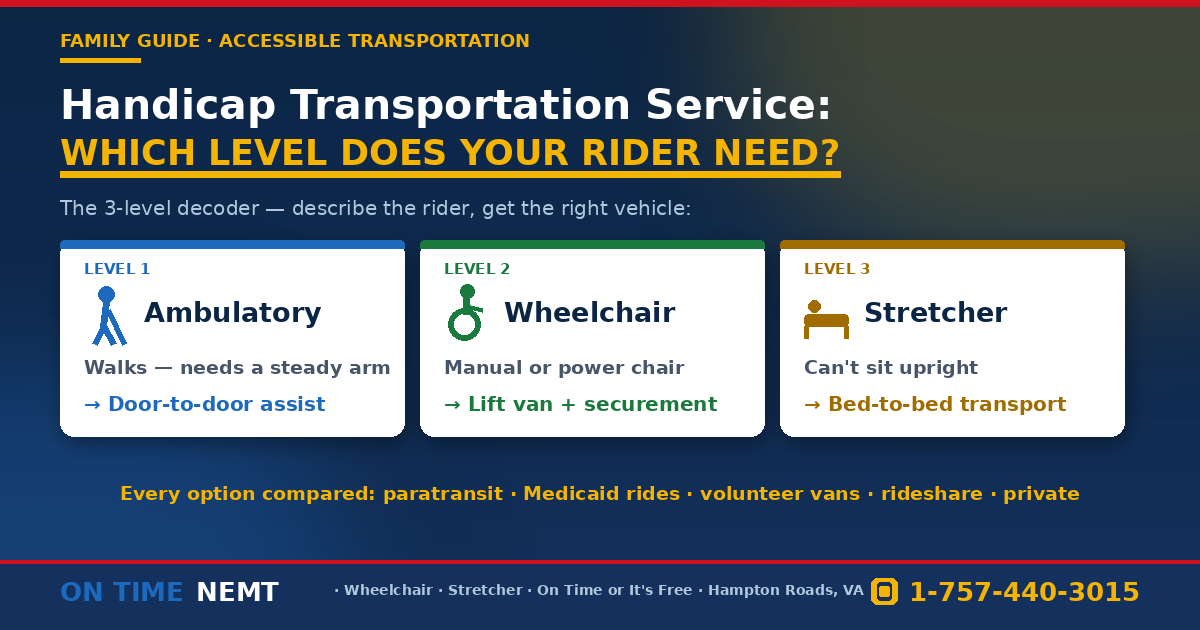
Many “no-shows” start with missing information. Give the provider: mobility level (walks, walker, manual or power chair, stretcher), approximate weight for bariatric needs, oxygen, the exact entrance or unit, gate or door codes, escort riding along, a reachable phone for the patient or family, and return-trip timing.
7. Vet providers with five questions
Before you trust a provider with a discharge or a standing dialysis schedule, ask:
- Will you commit to an exact pickup time, not a window?
- What happens when you’re late — is there a stated consequence?
- Who answers if something changes at 6 a.m. — a local person or a call center?
- Will you confirm trips in advance with me and the patient’s family?
- Are your rates published where families can see them before booking?
Word-for-Word Scripts for When the Ride Doesn’t Come
Copy these into your notes. They’re built to get answers fast and keep everyone calm.
Day-before confirmation
“Hi, I’m confirming tomorrow’s pickup for [patient] at [exact time] from [address/unit] to [destination]. They use a [mobility type]. Can you confirm the vehicle type and the number the driver will call when they arrive?”
15 minutes late — escalation call
“The pickup for [patient] was scheduled for [time] and it’s now [time]. I need the driver’s current location and a specific arrival time. If you can’t give me one in the next five minutes, I’ll need to cancel and arrange another provider — please note that on the trip record.”
Telling the family
“The scheduled ride hasn’t arrived and the company can’t give us a firm time. I have a backup provider who can be here by [time]. It’s a private-pay service — would you like me to arrange it so [patient] doesn’t miss [appointment/discharge]?”
Broker Ride vs. Private-Pay NEMT: When Each One Makes Sense
Being honest about this helps you and your patients. Medicaid broker rides are free for eligible members, and for flexible, low-stakes trips they can work fine. The question is which trips can’t afford to fail.
| Factor | Broker / benefit ride | Private-pay NEMT |
|---|---|---|
| Cost to patient | Usually free if eligible | Paid by patient or family (flat, published rates) |
| Booking notice | Often requires days of advance notice | Direct booking; same-day sometimes possible |
| Pickup timing | Commonly a pickup window | Exact scheduled time |
| Who you talk to | Call center, then a subcontractor | The company that dispatches the van |
| Best for | Flexible routine trips | Discharges, dialysis, oncology, surgery follow-ups, any trip that can’t fail |
Many case managers use both: the benefit ride as the default, and a private-pay provider as the backup lane for critical trips. Families can see On Time NEMT’s flat rates anytime on our pricing page, and our guide to private medical transportation explains the difference in detail.
How On Time NEMT Works With Case Managers in Chesapeake, Norfolk & Virginia Beach
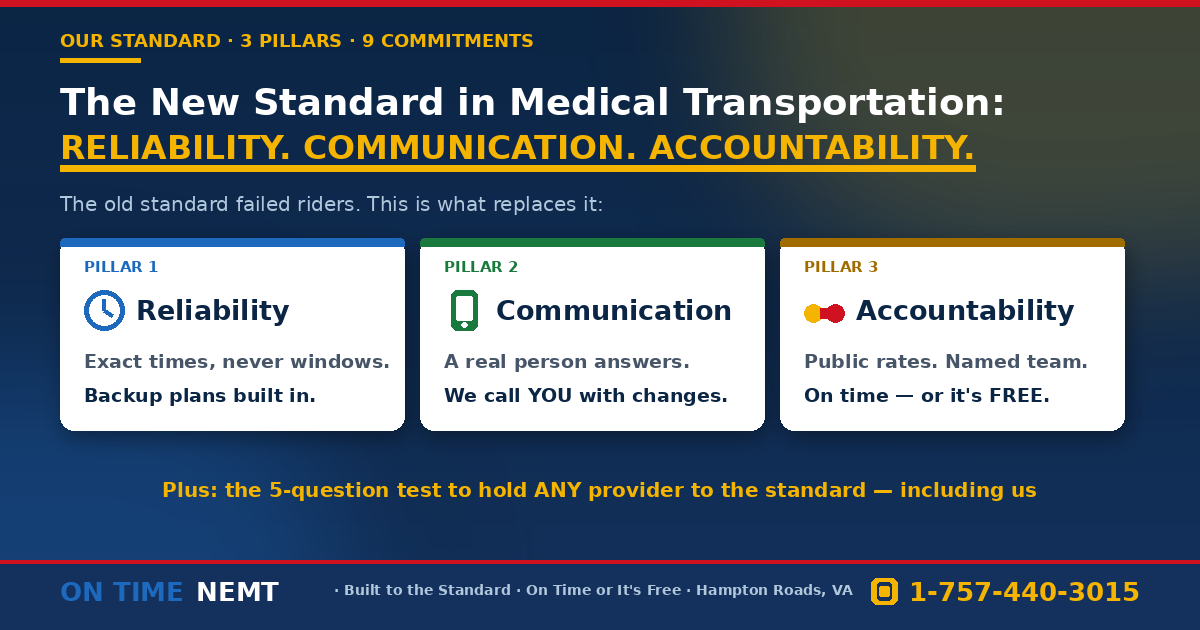
Before we opened, our founders spent three months talking with facility coordinators, healthcare administrators, and families, asking one question: what’s broken? The answer was almost always the same — rides that were late or never came, and nobody who answered for it. So we built On Time NEMT around fixing exactly that.
No windows. We schedule to the minute and work backward from the appointment.
We deliberately limit daily trips so one delay can’t cascade into yours.
A local team with the schedule in front of them — and the authority to change it.
Trip details confirmed in advance with the case manager and the family.
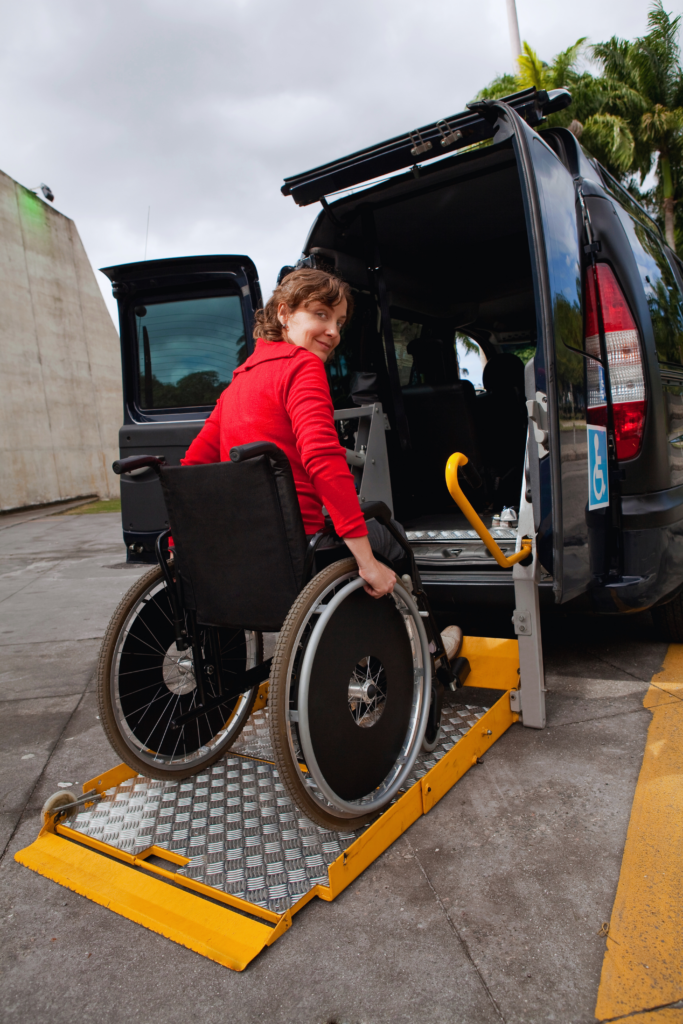
ADA-compliant ramp vans and non-emergency stretcher transport, door-to-door.
If we don’t get your patient there on time, the ride is free.*
We’re private-pay, so there’s no broker, no eligibility paperwork, and no waitlist — you or the family book directly. We handle standing dialysis schedules, hospital discharges, post-surgery rides, and long-distance trips up to 240 miles. If your facility schedules rides regularly, our facility partner program gives you a direct line to our team.
Where we serve:
Chesapeake Regional discharges, Great Bridge to Western Branch 📍 Norfolk, VA
Sentara Norfolk General and area clinics and rehab facilities 📍 Virginia Beach, VA
Our home city — Sentara VB General and Princess Anne
We’re expanding across Virginia. If your patient is outside Hampton Roads, call 1-757-440-3015 — long-distance trips to Richmond, Northern Virginia, and beyond are available.
Put a backup lane on file today
Save our number before the next ride fails. One call sets up the pickup, vehicle, and return trip.
Book a Ride → 📞 1-757-440-3015Frequently Asked Questions
Why does patient transportation keep not showing up?
Most failures are structural: pickup windows instead of exact times, overbooked shared routes, call centers that can’t dispatch, incomplete trip details, and no single company accountable when a ride fails. Choosing providers that commit to exact times and limit bookings removes most of the risk.
What should a case manager do when the ride doesn’t come?
At 15 minutes late, call for the driver’s location and a specific ETA. At 30 minutes with no firm answer, cancel and activate a backup provider. Document the scheduled time, actual outcome, confirmation number, who you spoke with, and the impact on the patient.
How can I prevent discharge delays caused by transportation?
Book transportation as soon as discharge is likely, request an exact pickup time, confirm the day before and two hours out, hand off complete mobility details, and keep a vetted private-pay provider on file so you can switch with one call.
Can a case manager book On Time NEMT for a patient?
Yes. Case managers, discharge planners, social workers, and family members can all book on a patient’s behalf by calling 1-757-440-3015 or using the contact form. We confirm trip details with you and, if you’d like, the patient’s family.
Do patients need Medicaid or insurance to use On Time NEMT?
No. On Time NEMT is private-pay, so there’s no broker, eligibility check, or waitlist. Rates are flat and published on our pricing page, so families know the cost before the trip.
Do you provide wheelchair and stretcher transport for discharges?
Yes. We provide ambulatory, ADA-compliant wheelchair, and non-emergency stretcher transport, door-to-door, for hospital discharges, facility transfers, dialysis, and follow-up appointments across Chesapeake, Norfolk, and Virginia Beach.
Can you handle same-day transportation requests?
Often, depending on the day’s schedule. Because we limit bookings to protect on-time performance, the earlier you call the better. For same-day needs, call 1-757-440-3015 directly rather than using the form.
Do you serve areas outside Hampton Roads?
Yes. Our core service area is Chesapeake, Norfolk, and Virginia Beach, and we are expanding across Virginia. We provide long-distance trips up to 240 miles, including to Richmond and Northern Virginia.
Keep reading
Sources
- Maine Legislature — testimony on LD 17 (Medicaid transportation)
- LeadingAge New York — Medicaid transportation concerns
- Wisconsin Legislative Audit Bureau — NEMT report 15-4
- MobiHealthNews — NEMT pilots and no-show reductions
- Bambi — reducing NEMT no-shows
- Kinetik — when transportation fails, care coordination breaks
Stop waiting on rides that never come.
Exact pickup times. A real person on the phone. On time — or the ride is free.
Book Your Ride → 📞 Call 1-757-440-3015On Time NEMT · 3837 Larchwood Drive, Virginia Beach, VA 23456 · Private-pay ambulatory, wheelchair & stretcher transportation serving Chesapeake, Norfolk, Virginia Beach, and expanding across Virginia. *On-time-or-free guarantee requires a scheduled pickup time that allows on-time arrival and the rider ready at pickup. For medical emergencies, call 911.